
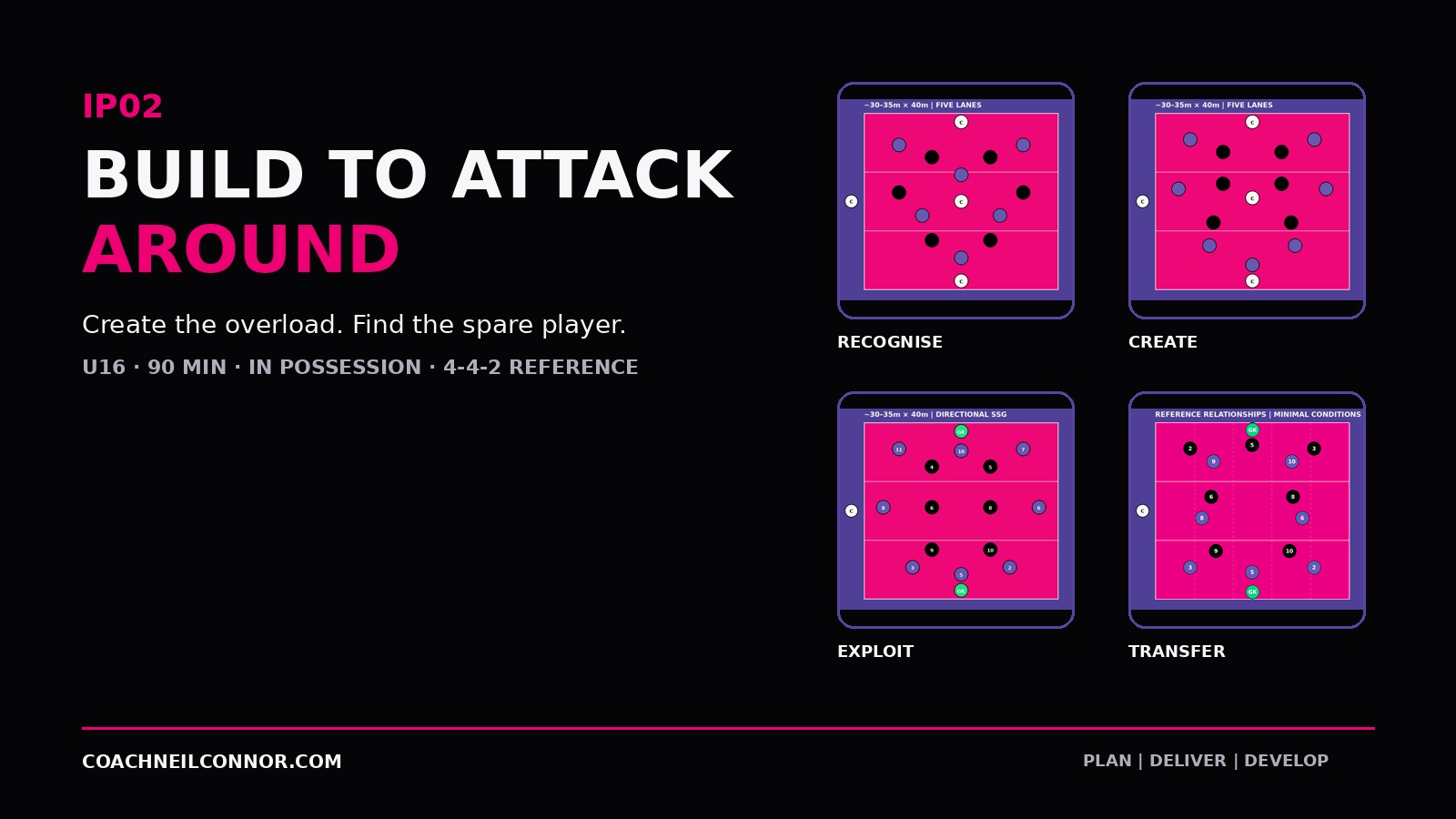
Session timeline
| Time | Stage | Practice type | Duration |
|---|---|---|---|
| 0–10 | Prepare | Physical preparation | 10 min |
| 10–22 | Connect | Specific practice | 12 min |
| 22–37 | A — Recognise | General practice | 15 min |
| 37–52 | B — Create | General practice | 15 min |
| 52–67 | C — Exploit | Small-sided game (SSG) | 15 min |
| 67–87 | Transfer | Small-sided game (SSG) | 20 min |
| 87–90 | Reflect | Reflection | 3 min |
Practice overview
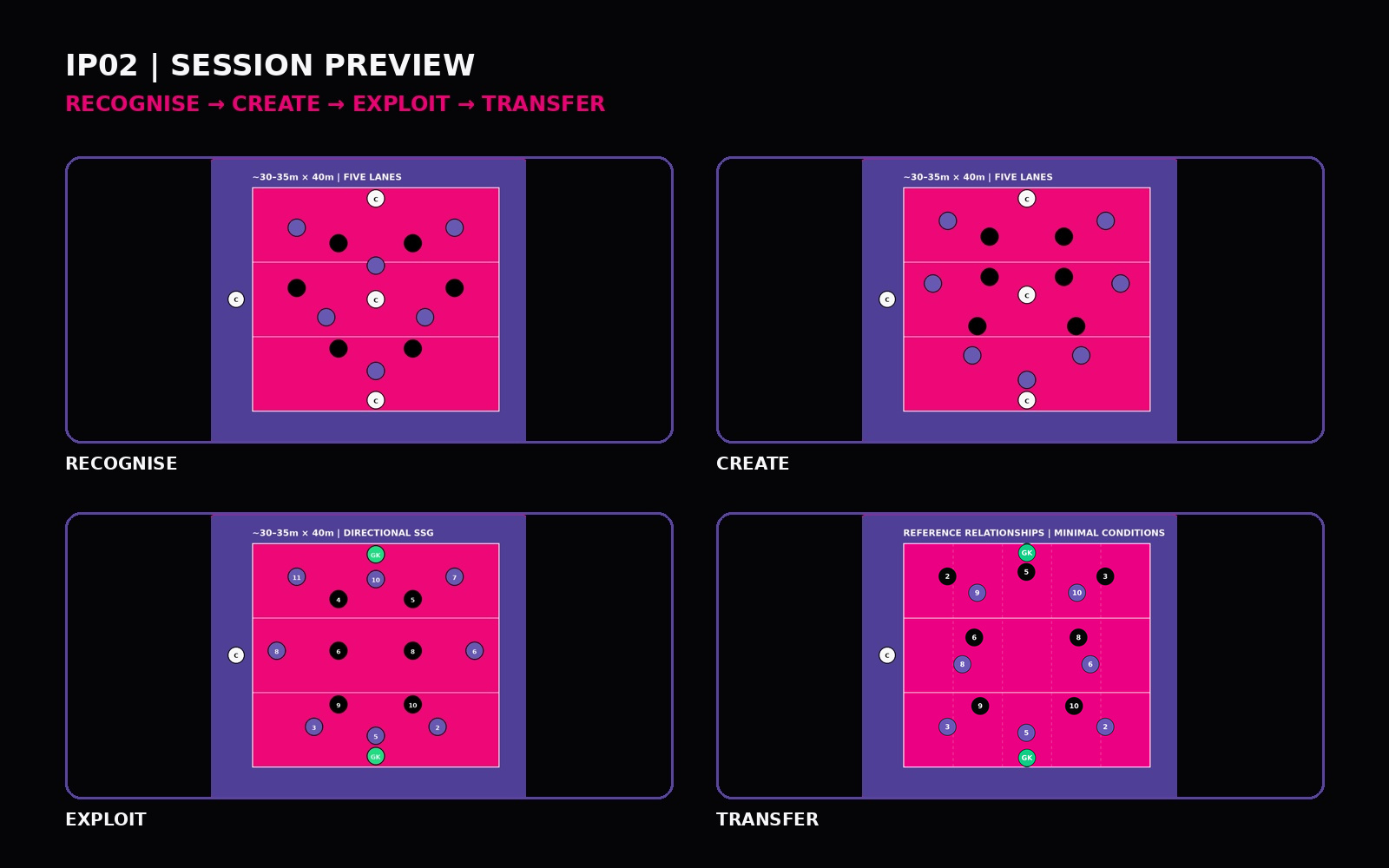
Use the five vertical lanes as positional references, not movement restrictions. The white C outside each pitch represents the coach and is excluded from player totals; white players inside A and B are common players.
Session purpose
The session moves from physical preparation and position-specific reference pictures into increasingly representative football problems. Players learn to recognise when central access is protected, create a wide overload, attack around the opposition and get back inside to threaten. The practices are linked by one learning objective rather than operating as isolated drills.
4-4-2 reference roles
- 1 - Goalkeeper | 2/3 - Full backs | 4/5 - Centre backs | 6/8 - Central midfielders | 7/11 - Wide midfielders | 9/10 - Forwards.
- In possession: retain width, depth, balance and occupation of the five lanes; use the outside player to create access back inside rather than treating circulation as the end objective.
Coaching approach
- Coach primarily one team and manage the opposition to provide realistic central protection and outside pressure.
- Use concurrent, individual, terminal, walk-through and coaching-process interventions according to the picture presented.
- Do not stop the practice merely to deliver planned content. Observe first; intervene when the intervention can improve recognition, overload creation or the inside return.
- Use questions and environmental manipulation before automatically giving the solution.
- Progressions and regressions are options, not compulsory stages.
- Primary observation lens throughout: did width and support change the picture, and did the team get back inside with purpose?
Opposition behaviour
- Protect central space and remain connected.
- Force play outside, but do not give up the inside return.
- Protect the outside-to-inside route and delay the final action.
- Recover quickly after the ball goes around.
- On regain, transition positively to maintain realism.
Success indicators
- Players recognise when central access is available and play through with appropriate timing and quality.
- Players recognise when the centre is protected and can create/use a wide overload without treating circulation as the end objective.
- Players go around the opposition and regain inside access through a pass, carry or combination.
- Players maintain balance while supporting the ball outside and the return inside.
- After getting back inside, players accelerate the attack and exploit the temporary advantage before the opposition reorganises.
- Players create and access spare players rather than simply passing because a numerical overload exists.
Physical preparation — Prepare
Free · Physical preparation · 10 minutes
Adapt to the group · Adaptable
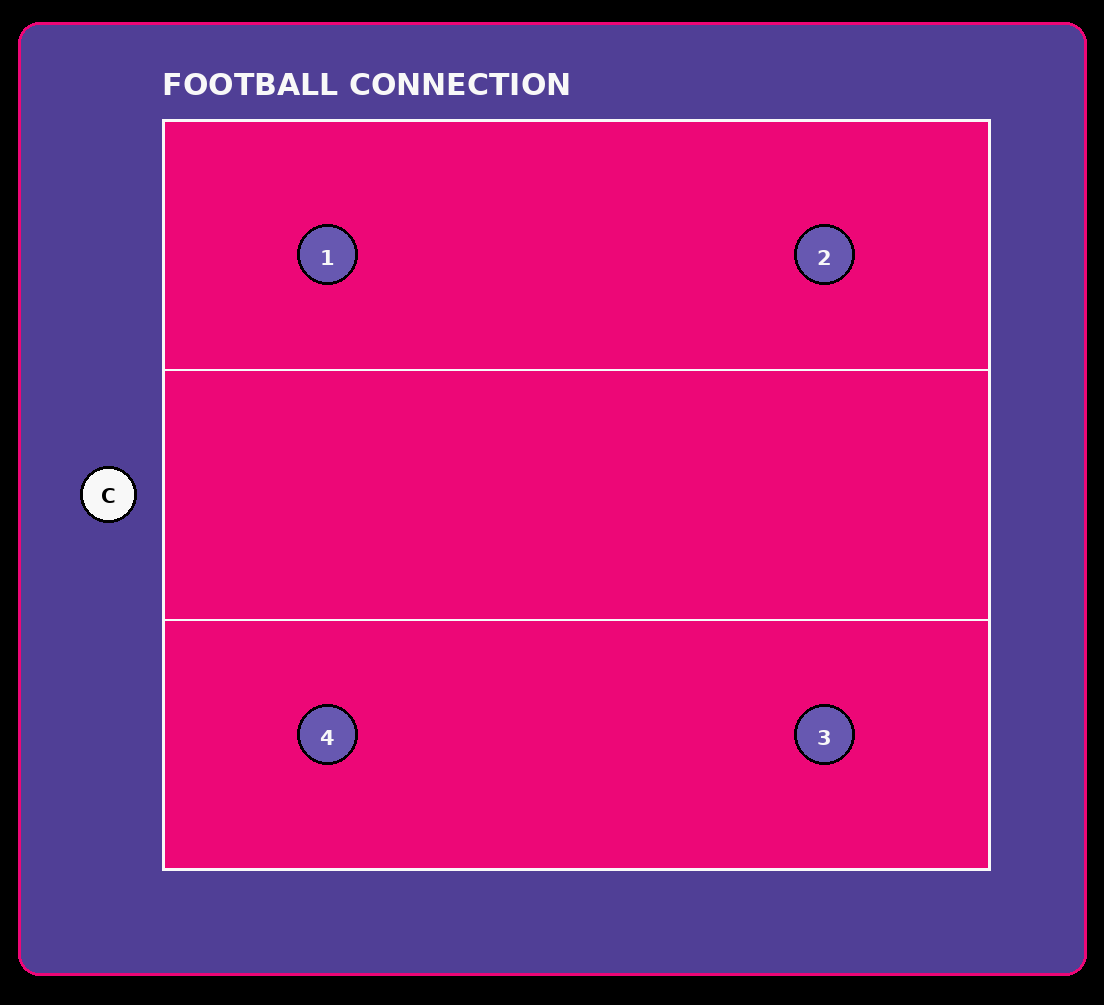
Illustrative movement layout; adapt the physical preparation to the group.
- Duration: 10 minutes
- Practice Type: Physical preparation / activation
- Purpose: Prepare players physically and cognitively for repeated wide-to-inside actions, changes of direction and accelerations around pressure.
- Ownership: S&C-led; football plan defines movement outcomes rather than prescribing the exact physical programme.
Physical emphasis: Multidirectional movement; acceleration/deceleration; lateral shuffle; change of direction; hip mobility/opening; short explosive actions; reaction to visual information; readiness to repeat actions around and back inside.
Football connection: Where appropriate: check away → accelerate outside; open body → receive forward; support underneath → combine; overlap/underlap → accelerate beyond; get back inside → finish or connect.
Coach observation: Players finish physically prepared to enter football work immediately. Use football actions as cues, but do not turn this phase into a tactical lecture.
- TRANSITION Wide-channel equipment and two goals should already be set so the session moves directly from physical preparation into football.
Position-specific work — Connect
Free · Specific practice · 12 minutes
4-4-2 positional relationships · Adaptable
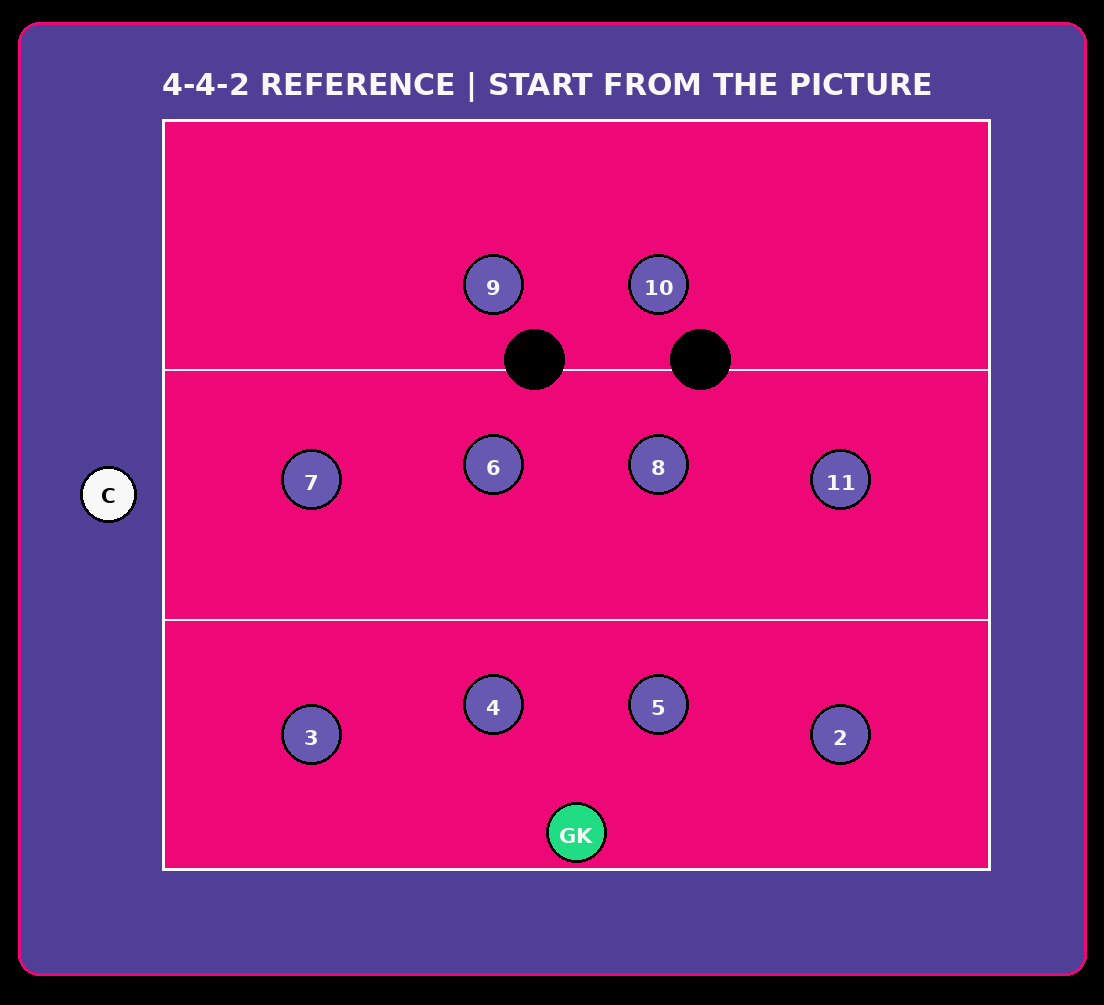
A positional reference picture; use both sides where numbers permit and vary the pressure.
- Duration: 12 minutes
- Practice Type: Position Specific
- Reference: 4-4-2 wide relationships and five-lane occupation
- Primary Purpose: Connect Build to Attack Around to recognisable 4-4-2 relationships, with width, support and balance.
Organisation: Use both sides where numbers permit. Start from realistic 4-4-2 reference positions, using five vertical lanes to make width and inside access visible. Present a small number of starting pictures, then progress to choice based on pressure.
- THROUGH - If the central route is open, do not force the wide solution. CB → CM → forward; 6/8 receives beyond pressure and plays forward.
- AROUND - Central route protected. CB → FB → wide midfielder → forward/inside player. The wide player fixes or attracts pressure so the next pass can get back inside.
- OVER - If the opposition presses high and space is available beyond, recognise when GK/CB can play over; 7/11 or 9/10 provide appropriate movement.
- CARRY - If the defender does not engage, CB/CM/wide player carries to commit pressure before releasing or combining around.
Positional detail: GK: scan/support/pass range. CB: body orientation, carry, disguise, forward pass. FB: width and timing. 6/8: support underneath, scan, receive to play forward. 7/11: hold width, fix defender, combine, move inside/beyond. 9/10: pin, connect, threaten behind and attack the inside return.
Progression (Harder): Move from fixed reference pictures into choice. Change the defensive pressure so players must recognise whether to play through, around, over or carry, then get back inside.
Regression (Easier): Reduce or temporarily remove pressure to rehearse the wide overload and inside return, then reintroduce the decision.
Coach Observation: Avoid making “around” a fixed script. The evidence is whether width, support and timing change the picture and create an inside route.
A — Recognise
Free · General practice · 15 minutes · Part A of 3
6v6 + 3 common players · 30–35 × 40 m
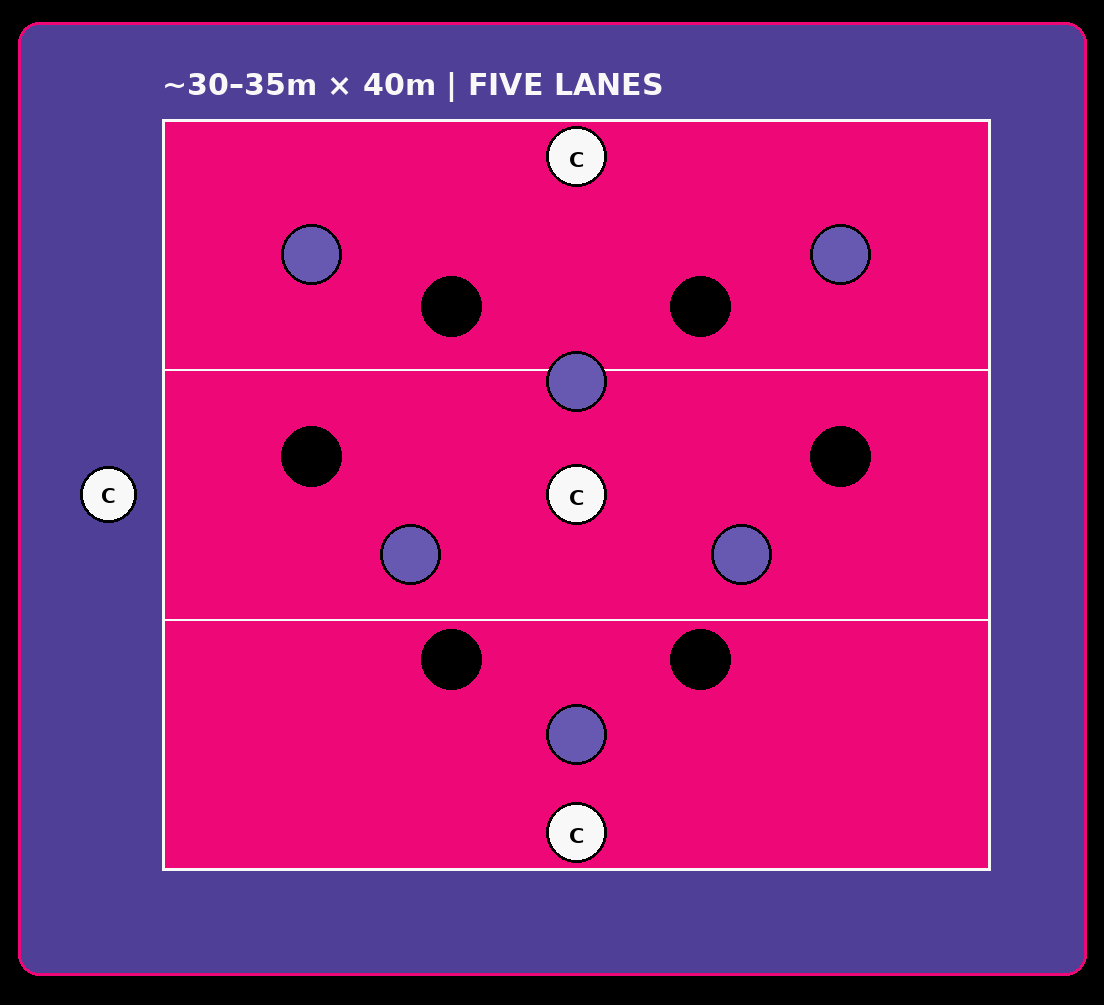
- Duration: 15 minutes
- Practice Type: General Practice / Possession
- Organisation: 6v6 + 3 common players; one common player at each end and one internal common player. Total = 15 players.
- Area: Approx. 30-35m x 40m; five vertical lanes (L1-L5).
- Focus: Recognise central protection and use the outside solution.
Explanation: Transfer from one end common player to the other. The internal common supports possession. Recognise central protection, use the outside lane and get back inside. Direction reverses after a successful transfer.
- PLAYER PROBLEM Can we recognise when the centre is protected, use the outside player and get back inside?
Start condition: Free play. No touch restriction, mandatory wide pass or compulsory use of every common player.
Technical detail: Scan before receiving; receive to see forward; first touch away from pressure; pass with appropriate weight/direction; disguise; carry when space is available; finish the action with quality.
Tactical detail: Recognise central protection; create width and depth; find the spare outside player; support underneath; combine/overlap/underlap; get back inside; play forward when appropriate.
Challenges / Conditions / Targets: Begin without conditions. If required: successful end-to-end transfer = 1 point; transfer that goes around pressure and returns inside = 3 points.
Progression (Harder): Reduce space; restrict common-player time; allow pressure on end common players; remove the internal common player or narrow one side.
Regression (Easier): Increase area; free the common players; reduce opposition pressure; restart from the outside lane.
Coach Questions: What is the opposition protecting? Where is the spare player? Can we go forward? If the centre is closed, how do we get around and back inside?
Coach Observation: Do not treat every wide pass as success. Judge whether the players recognised central protection, created the overload and used the outside route to regain inside access.
B — Create
Free · General practice · 15 minutes · Part B of 3
7v6 + 3 common players · 30–35 × 40 m
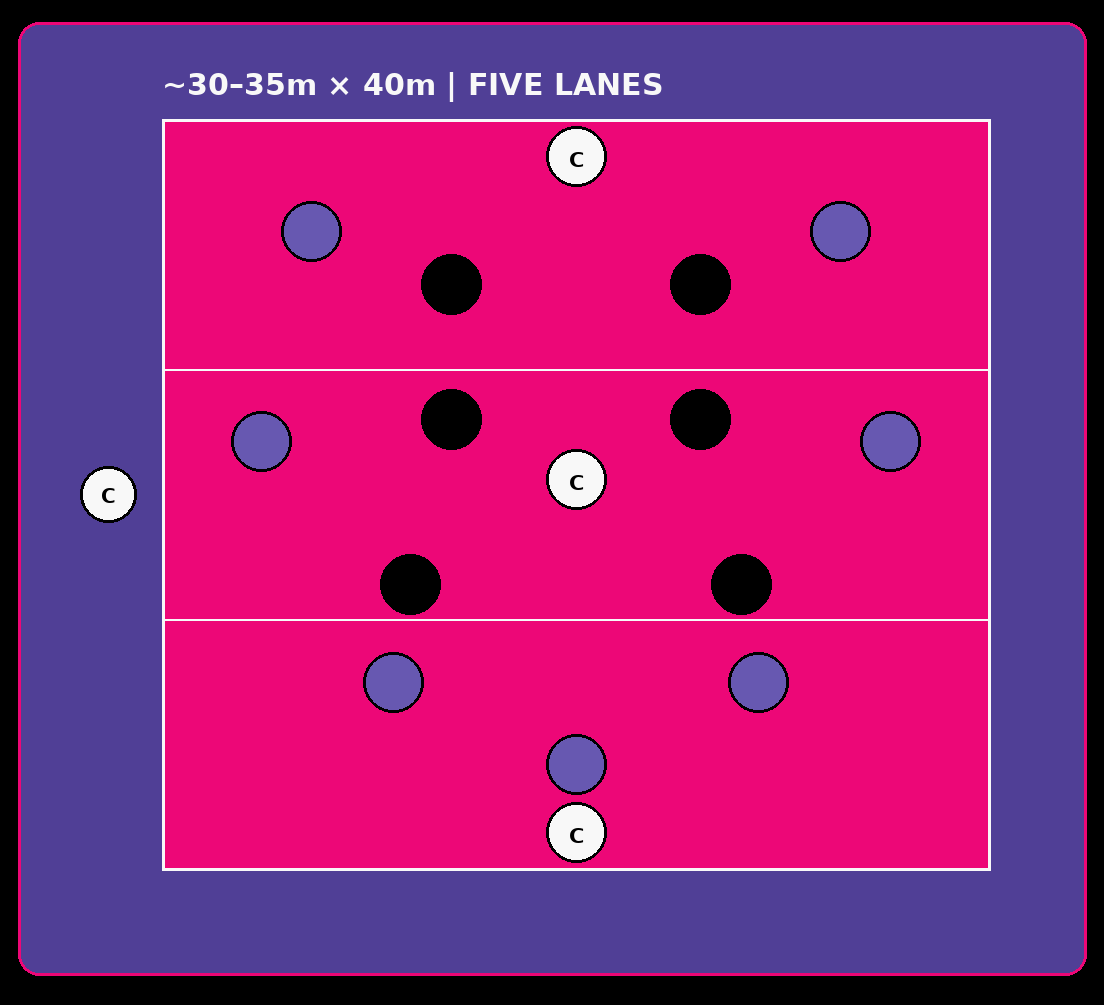
- Duration: 15 minutes
- Practice Type: General / Wide Overload
- Organisation: 7v6 + 3 common players (16 total); approx. 30-35m x 40m; five-lane reference (L1-L5).
- Focus: Create a 2v1 outside, progress around the opposition and regain inside access.
- PLAYER PROBLEM Can we create the wide overload, go around the opposition and return inside with purpose?
Key behaviour: Find the wide spare → commit the defender → release → move, but not as a compulsory sequence. If the defender does not engage, continue carrying or retain.
Coaching detail: Effective width; support angle/distance; carry at the defender; commit; timing of release; overlap/underlap; movement beyond; third-player combination; accelerate back inside after going around.
Progression (Harder): Start with 2v1 in the outside lane; add a recovering defender; then allow the opposition to choose when/where to press so the overload must be created.
Regression (Easier): Increase width; return to 2v1; manipulate defender starting position so the spare player and inside return are clearer.
Coach Questions: Who is spare? What makes the defender commit? When do we release? Who supports underneath? How do we get back inside after going around?
Coach Observation: Do not reward a wide pass merely because an overload exists. The correct decision may be to carry, retain or wait until pressure commits.
C — Exploit
Free · Small-sided game (SSG) · 15 minutes · Part C of 3
8v6 + 2 goalkeepers · 30–35 × 40 m
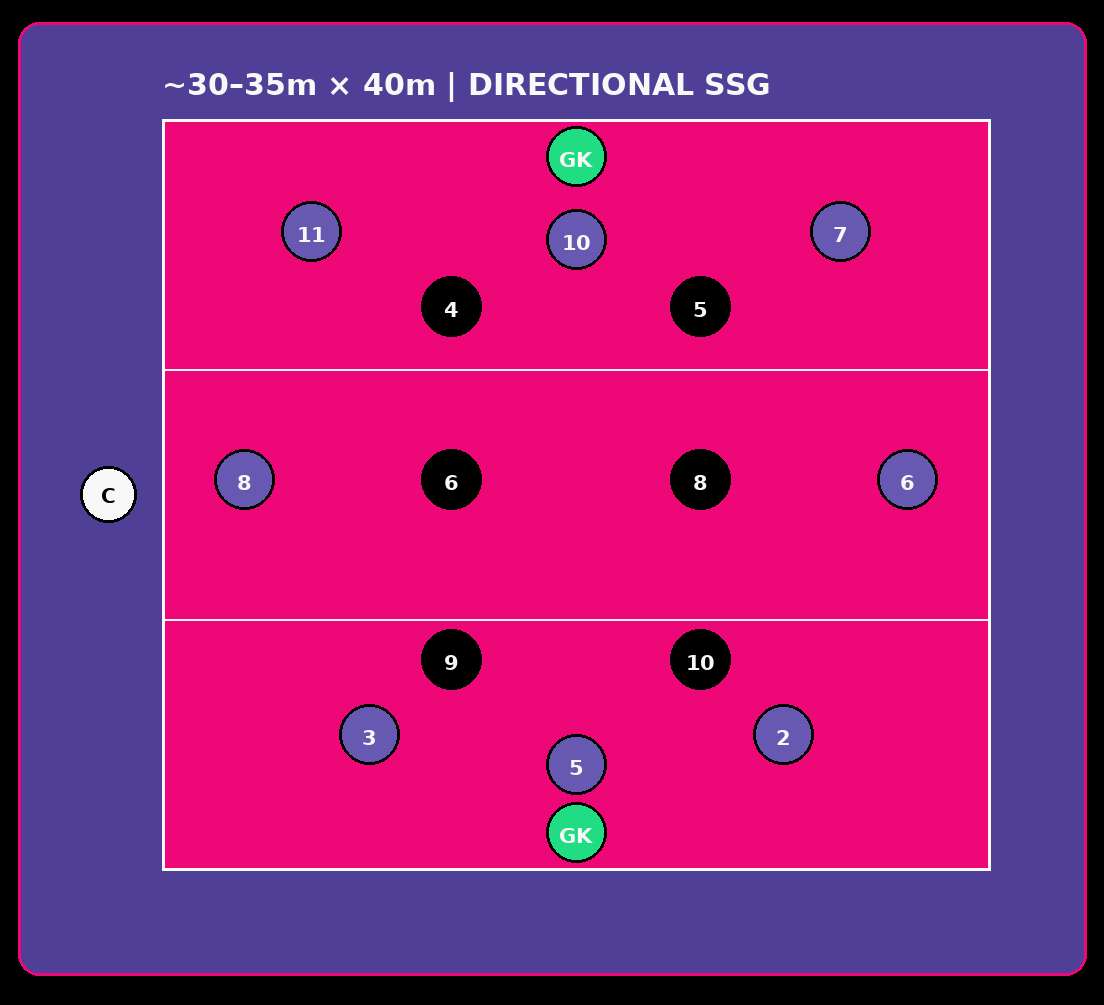
- Duration: 15 minutes
- Practice Type: Directional Small-Sided Game
- Organisation: 8v6 + 2 goalkeepers; two goals. Coached team has 8 outfield players, opposition has 6, and both GKs are active. Total = 16 players.
- Area: Approx. 30-35m x 40m; vertical five-lane reference (L1-L5); adjust only if realism or intensity is lost.
- Focus: Exploit a wide overload, attack around and get back inside to threaten goal.
Scoring: Goal = 1. Goal after attacking around and getting back inside = 3.
Qualifying line break: A qualifying attack goes outside through a wide overload, then returns inside through a pass, combination, carry or third-player action before the finish.
- PLAYER PROBLEM Once we go around, can we get back inside quickly enough to threaten goal before the opposition recover?
Before the attack: Scan; recognise central protection; hold width/depth; find the spare player; pin or move opponents; maintain balance behind the ball.
Around the opposition: Quality of pass/carry; receive forward; positive first touch; overlap/underlap; movement beyond; support around the ball.
Back inside: Accelerate; attack the inside return; support forward; finish or connect before the opposition reorganises.
Progression (Harder): If players go around but allow recovery, add a bonus for scoring within approximately six seconds of getting back inside. Reduce space or add a recovering defender if appropriate.
Regression (Easier): Increase area; allow an extra attacking player; reduce defensive numbers; give the wide player more time to receive and face forward.
Coach Observation: Do not allow the practice to become a crossing or finishing session. Observe what created the overload, how the team went around, and how quickly it regained inside access.
Representative game — Transfer
Free · Small-sided game (SSG) · 20 minutes
7v7 + 2 goalkeepers; 7v6 + 2 with 15 · 30–35 × 40 m
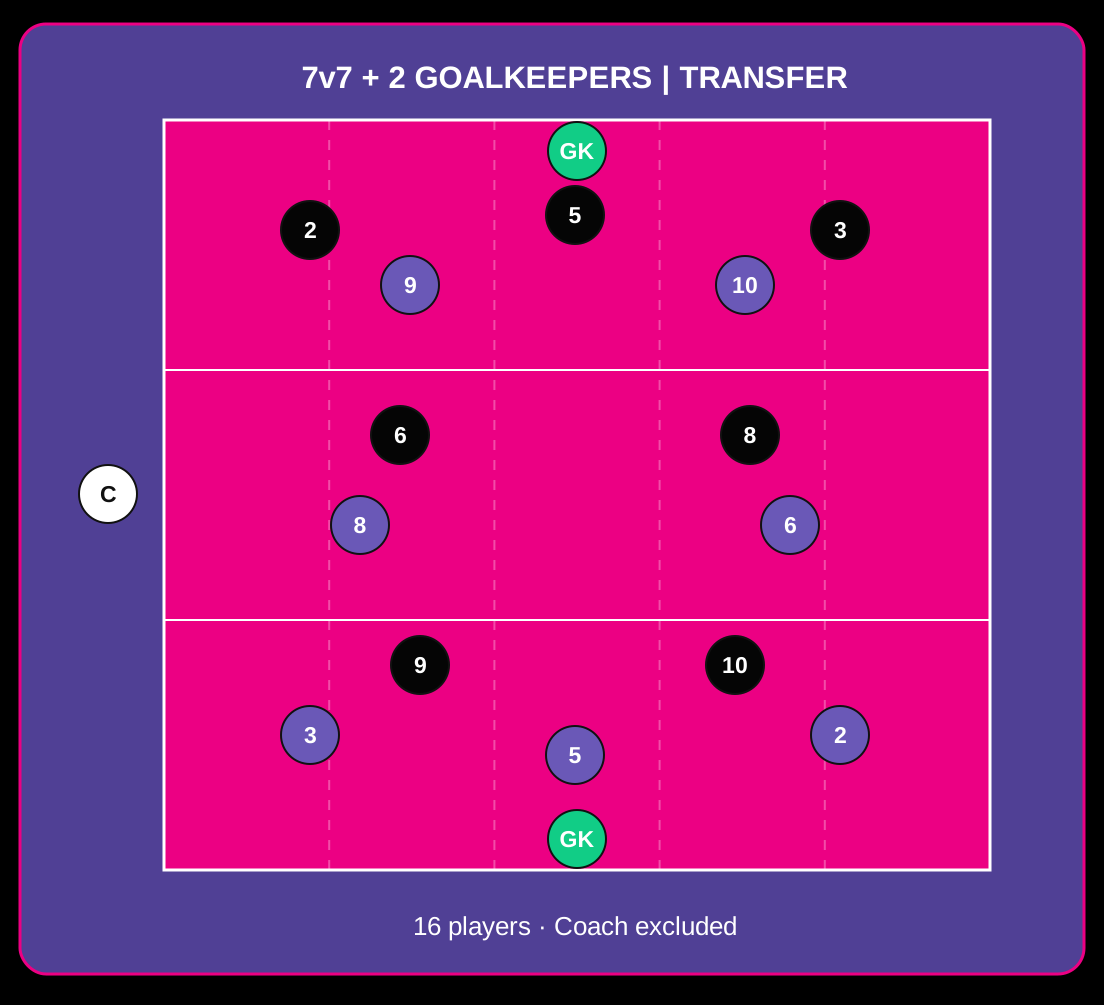
16-player example: seven outfield players and a goalkeeper per team. The 4-4-2 is a relationship reference, adapted to the available players.
- Duration: 20 minutes
- Practice Type: Representative Game
- Reference: 4-4-2 relationships; use 7v7 + 2 GKs with 16 players, or 7v6 + 2 GKs with 15.
- Structure: Block 1: coached game 8-10 min. Block 2: free game 10-12 min. Use the same five-lane references, then remove most conditions.
Block 1 - coached game: Minimal conditions. Look for transfer of Build to Attack Around into positional football.
- CB/GK: recognise when to play through, around, over or carry; secure balance behind the ball.
- 6/8: support underneath, create the overload, receive forward and connect to the inside return.
- FBs: provide width, timing and the outside route; support balance if the ball travels inside.
- 7/11: hold width, fix the defender, combine, move inside and threaten beyond.
- 9/10: pin, connect, attack the inside return and create space for one another.
- Team: maintain balance behind the ball while supporting forward progression and inside access.
Managed opposition: Protect central space; prevent easy inside access; force outside without overcommitting; protect the inside return; transition positively on regain.
Block 2 - free game: Remove bonus scoring and most conditions. Play football. Coach mainly through observation and concise concurrent information.
Transfer test: Do players still create the wide overload, go around and get back inside once the practice stops explicitly rewarding it?
Player debrief and coach reflection
Free · Reflection · 3 minutes
Whole group · Adaptable
- Duration: 3 minutes
- Purpose: Consolidate understanding through concise player reflection on central protection, the wide overload and the inside return.
- What tells us that the centre is protected and the around solution is available?
- How can we create and use the spare player outside?
- What should we do immediately after going around the opposition?
Coach reflection
Principle: Did players improve their ability to build to attack around?
Decision Making: Were players choosing the outside solution from pressure, or simply following a practice rule?
Transfer: Did behaviours from A/B/C appear in the final game without prompting?
Position Specific: Which relationships need further work: GK/CB, FB/Wide, CB/CM, CM/Forward, Front Two?
Individuals: Who recognised central protection? Who struggled to create width? Who failed to support around the ball? Who consistently got back inside?
Practice Design: What was too easy, too difficult, unnecessary or missing?
Live Adaptation: What did I change during delivery, and why?
Next Action: What learning should transfer into the next in-possession session?
Source alignment
Framework terminology and practice-design fields are aligned to the supplied FAW Welsh Way, FAW Breaking Lines General Practice, FAW Practice Design, and Coaches' Voice / SSP examples. This is an NC-branded planning document based on those structures; it is not an official FAW template.
- Welsh Way: Build with Balance; Create & Exploit Overload; Find the Spare Player.
- FAW practice fields: organisation/area, explanation, challenges/conditions/targets, key points and interventions.
- Coaches' Voice / SSP fields: focus area, players, timings, progressions/regressions and positional/individual detail.
- Advanced additions: session rationale, success indicators, opposition behaviour, transfer test and post-session reflection.