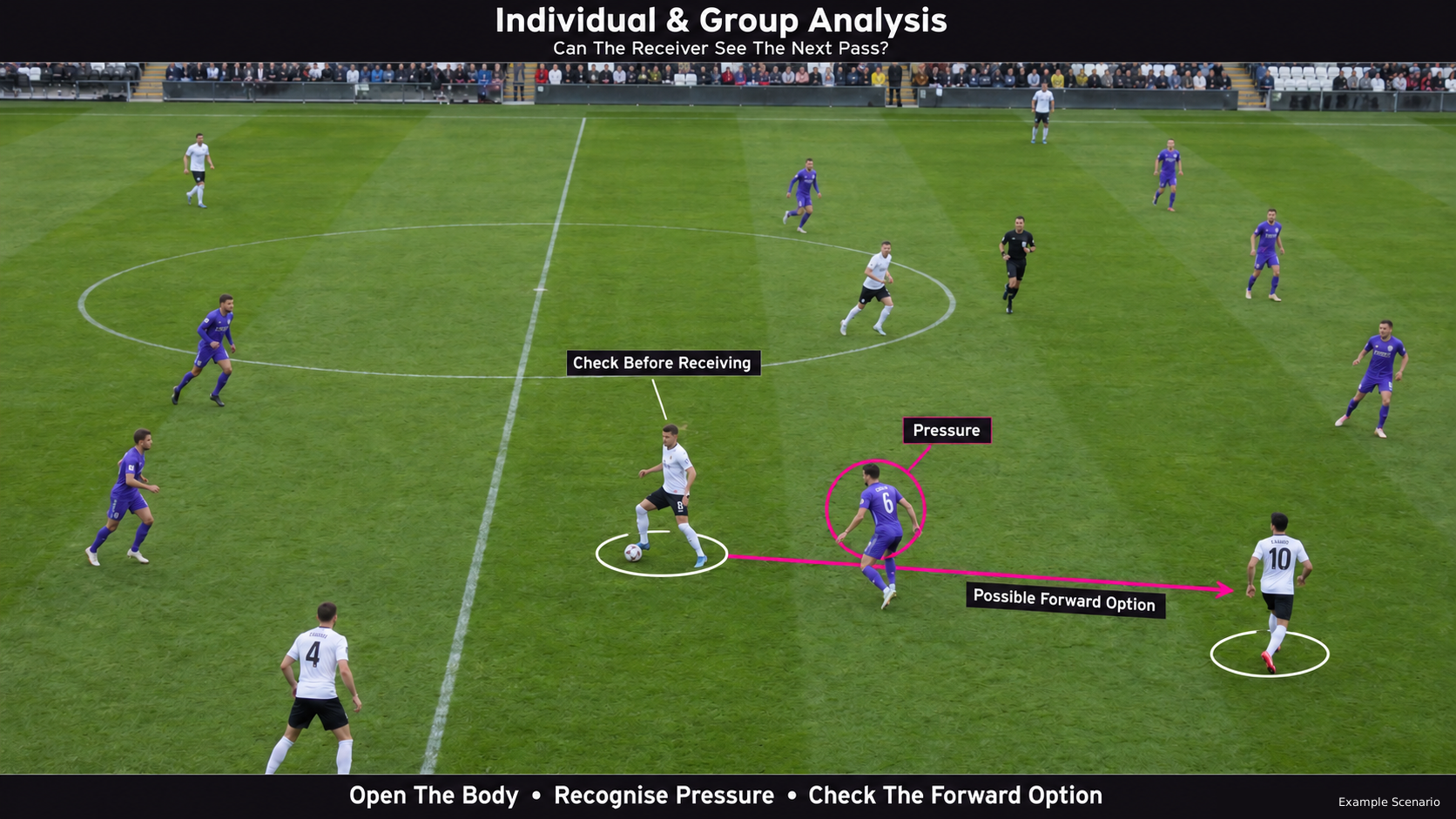
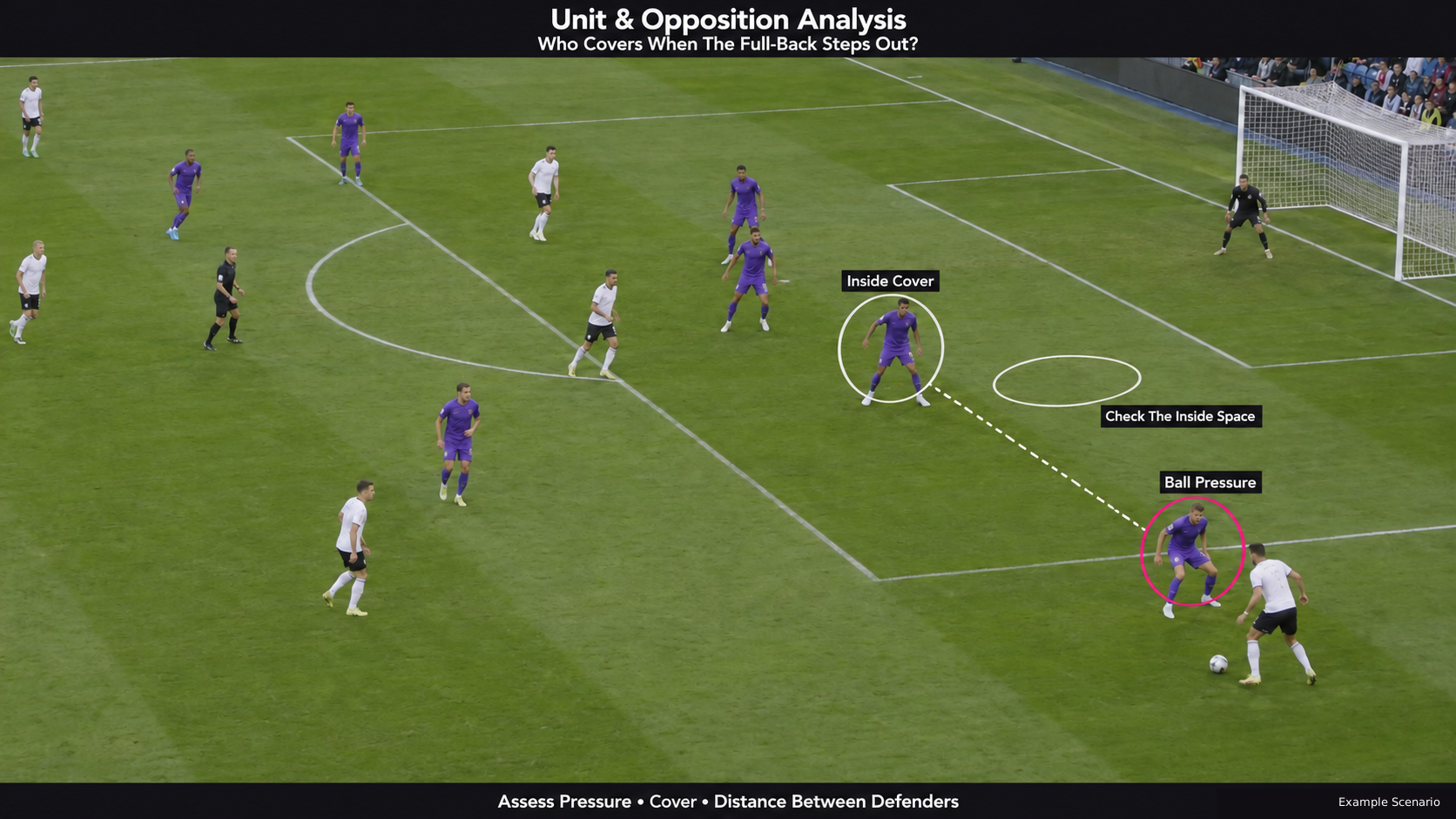
Annotated example scenes showing the player relationships and questions to examine. They illustrate what to examine; a still image cannot establish timing, intent or a recurring pattern.
Receiving Under Pressure
The white 8 receives near the halfway line, with purple 6 close enough to affect the next action. White 4 provides support behind the ball and white 10 offers an option to the right.
Assess the receiver’s orientation, the approaching defender and the next passing option. The highlighted route needs checking: the defender may block or intercept it. Review the sequence before judging the decision.
Pause before the pass arrives and ask the player to identify the nearest pressure, the support behind and the option ahead. Replay the action at normal speed, then compare the first touch and next decision with the information gathered. A useful practice cue should come from that discussion, rather than from the arrow alone.
The white ball carrier is outside the penalty area on the right. A purple defender engages the ball while another purple defender sits inside and behind that pressure. The goalkeeper and remaining defenders provide the context: the review asks whether the inside space is protected as the nearest defender moves towards the ball.
Examine the defender engaging the ball, the nearest covering defender and the space between them. Use the moving sequence to assess whether the unit shifts together and protects the inside route.
Follow the ball carrier and the two nearest purple defenders through the sequence. Consider the distance between pressure and cover, the angle of approach and whether the inside defender can protect space without leaving another attacker free. Turn the observation into a shared defensive cue, then review it in a comparable situation.
A detailed review of one player’s actions, decisions and movement within the match context.
Look beyond the player’s touches to the information available before receiving, body orientation, movement away from the ball and response when possession changes. Review actions against the demands of the position, the support available and the pressure applied by opponents.
How It Helps
Selected clips and a focused player report can identify strengths, a manageable development priority and an action to revisit in training and future matches.
What We Examine
Positioning and scanning
On- and off-ball actions
Technical execution under pressure
Transitions and decision-making
Annotated clips and individual findings
02
Unit Analysis
Examine how a defensive, midfield or attacking unit operates together and connects with the rest of the team.
Follow the unit as the ball and opposition move: who engages, who covers and whether the remaining players protect the next space. Compare distances, timing and coordination across several sequences, including how the unit receives support from the lines ahead and behind.
How It Helps
Annotated sequences and a unit summary help coaches plan linked practices, clarify shared responsibilities and review whether the players recognise the same cues.
What We Examine
Distances and compactness
Cover, balance and support
Line movement and coordination
Connections between units
Unit strengths and recurring issues
03
Group Analysis
Review the relationships between a selected group of players around a specific match situation.
Focus on a local relationship, such as a full-back, winger and midfielder combining in a wide area, or two players coordinating a press. Examine the angles, timing and communication that create or remove an advantage, including the opponents and space surrounding the action.
How It Helps
A small set of clips and relationship diagrams can support a clear discussion about combinations, support positions and the cues to carry into a practice.
What We Examine
Local combinations and support
Overloads and numerical relationships
Pressing partnerships
Movement and communication cues
Repeated interactions in context
04
Team Analysis
Analyse the whole team’s performance across the phases of play and against its intended game model.
Review how the team creates and protects space through build-up, progression, chance creation, defending and transitions. Compare repeated behaviours with the intended playing principles, while considering the opposition, score, match period and changes in personnel or structure.
How It Helps
A team report connects the main patterns to selected evidence and practical coaching priorities, helping staff shape the next training block and monitor the same themes over time.
What We Examine
Build-up and progression
Chance creation and finishing
Defensive organisation and pressing
Attacking and defensive transitions
Team patterns and game-model alignment
05
Opposition Analysis
Identify an opponent’s recurring behaviours, strengths and vulnerabilities to inform match preparation.
Study how the opponent progresses the ball, creates chances, presses and reacts when possession changes. Look for recurring tendencies across available footage, distinguish team patterns from individual actions and consider how those behaviours may change against a different opponent.
How It Helps
A concise preparation report brings together key clips, tactical relationships and questions for the coaching staff, supporting a match plan and player briefing rather than promising how the opponent will play.
What We Examine
Build-up patterns and progression routes
Attacking threats and key relationships
Defensive shape and pressing cues
Transitions and set pieces
Spaces and tendencies to investigate
The Output
Clear Evidence. A Focused Message.
Selected Match View
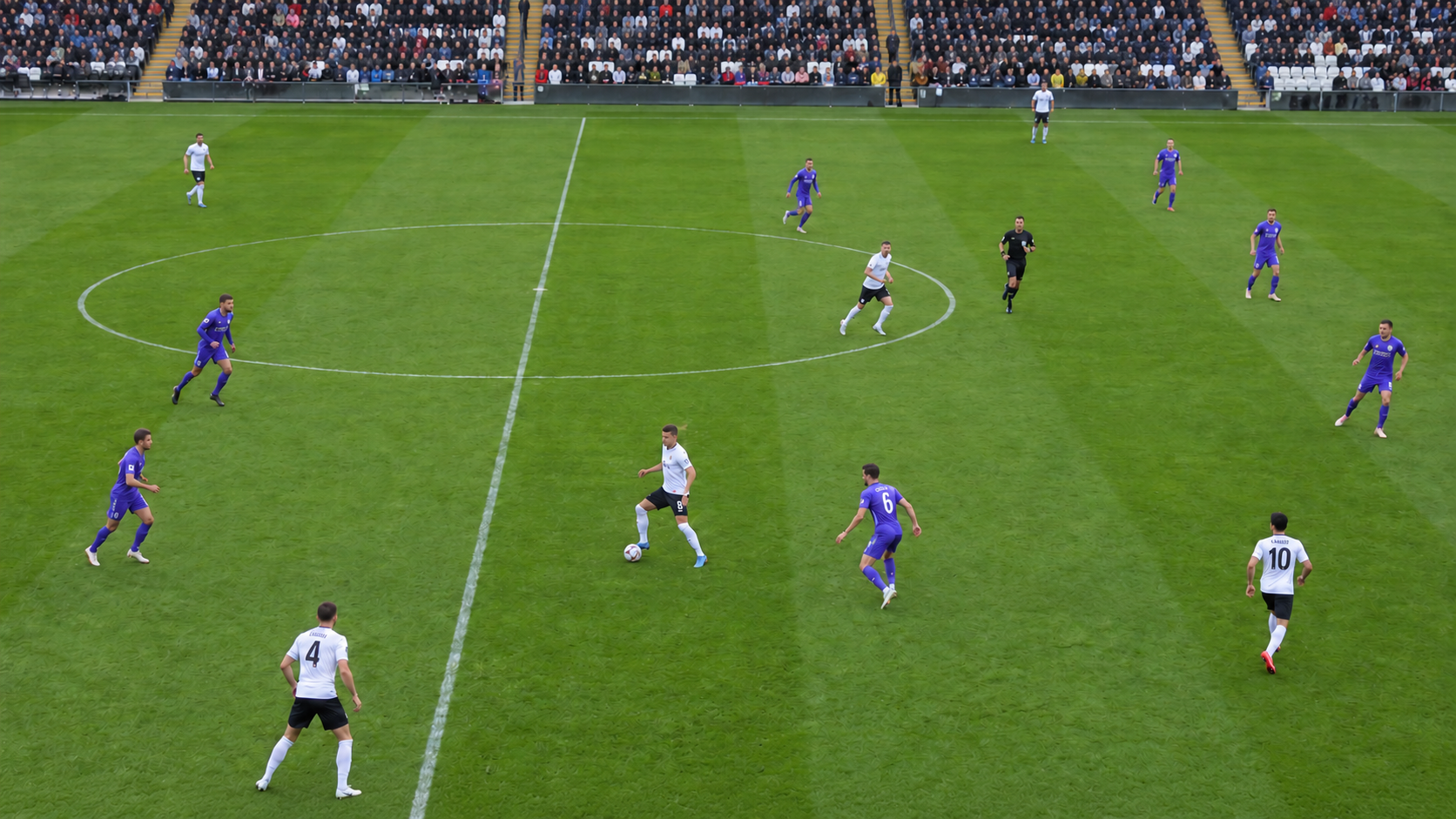
Begin with the complete picture before selecting a highlight. This example shows the receiver, the approaching opponent and the support available around the ball. The unannotated view gives the player and coach space to identify what they notice first.
The review starts before the first touch: where does the player look, how is the body positioned and which passing options remain available as pressure arrives? The surrounding players matter just as much as the action on the ball, because their movement can create an option or close a route.
In a match review, the sequence before and after this moment would be replayed at normal speed. That helps distinguish the options visible in a still from those the player could realistically recognise and execute.
From review to practice
Agree one review question, then select complete sequences that let the player and coach examine it together.
Annotations guide attention to the receiver, the pressing opponent and a possible forward option. They make a specific coaching question easier to discuss without asking the player to interpret every detail of the scene at once.
Here, the white-shirted receiver is close to a purple-shirted defender, with a teammate available farther to the right. The highlighted route is an option to investigate: the opponent may still intercept it, and the pass depends on timing, ball speed and the receiver’s first touch.
The useful conversation is about what information the player gathered and how it shaped the next action. Replay the moment without markings, add only the relevant annotations, then let the player explain the options they saw.
From review to practice
Use the markings to support a player conversation, then test the interpretation against the moving sequence.
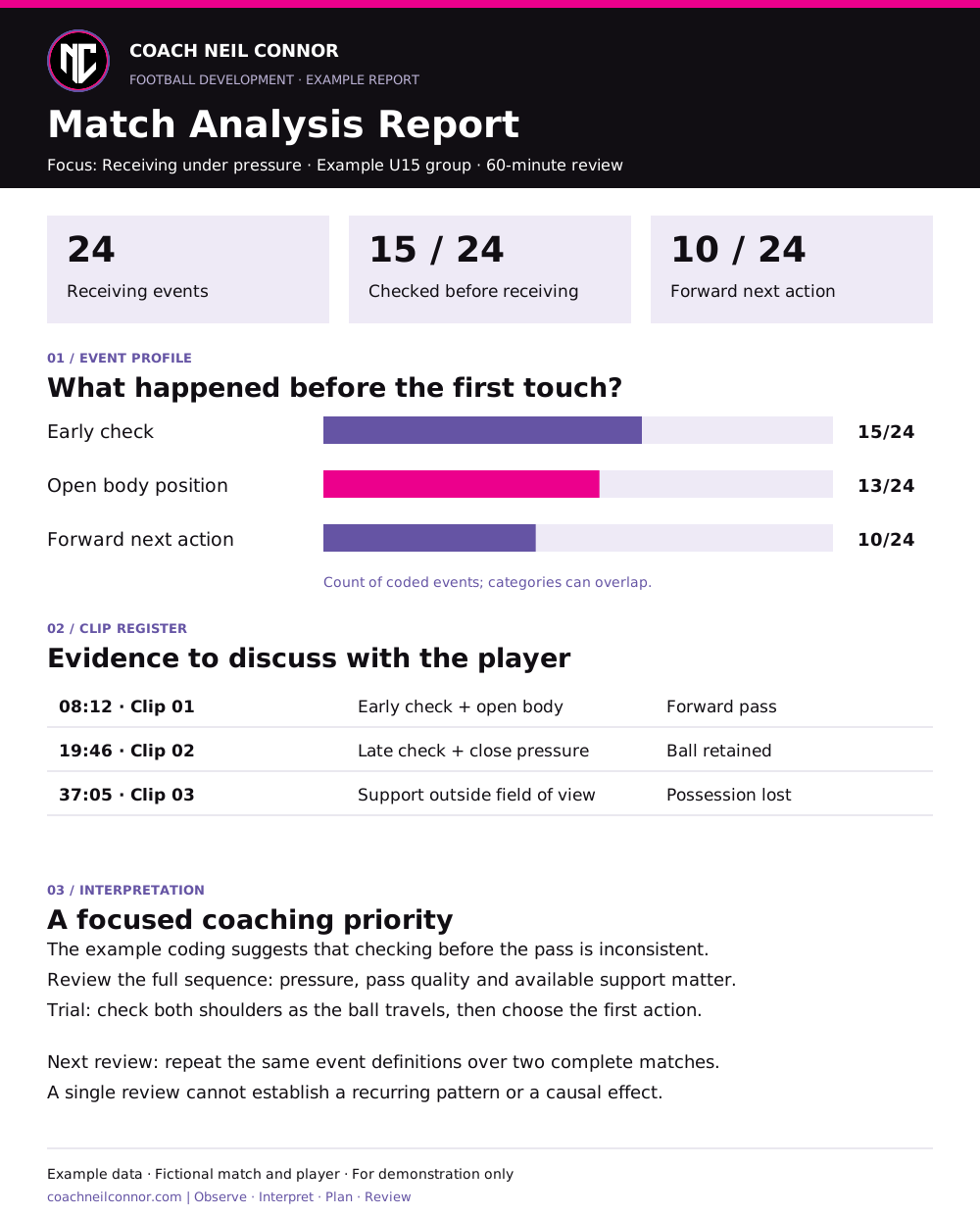
The report brings the observations, selected clips and coaching interpretation into one place. Its event profile shows how often a defined behaviour occurred, while the clip register lets the player or coach return to the sequences behind the numbers.
In this example, 24 receiving events are coded: an early check is recorded in 15, an open body position in 13 and a forward next action in 10. These categories can overlap. The bars describe the example review; they are not a player score or proof that one behaviour caused another.
The next step is to compare contrasting clips. What changed when the player checked early? Was the support different, did the pressure arrive sooner, or did the quality of the pass restrict the next action? Those questions keep the interpretation connected to the match context.
The final section turns the review into one manageable practice priority and a follow-up question. Use the same event definitions in later matches so the discussion can return to comparable evidence.
From review to practice
Choose one practice priority from the review and define what to look for next time. These example figures demonstrate the format; actual findings come from the supplied footage and agreed scope.
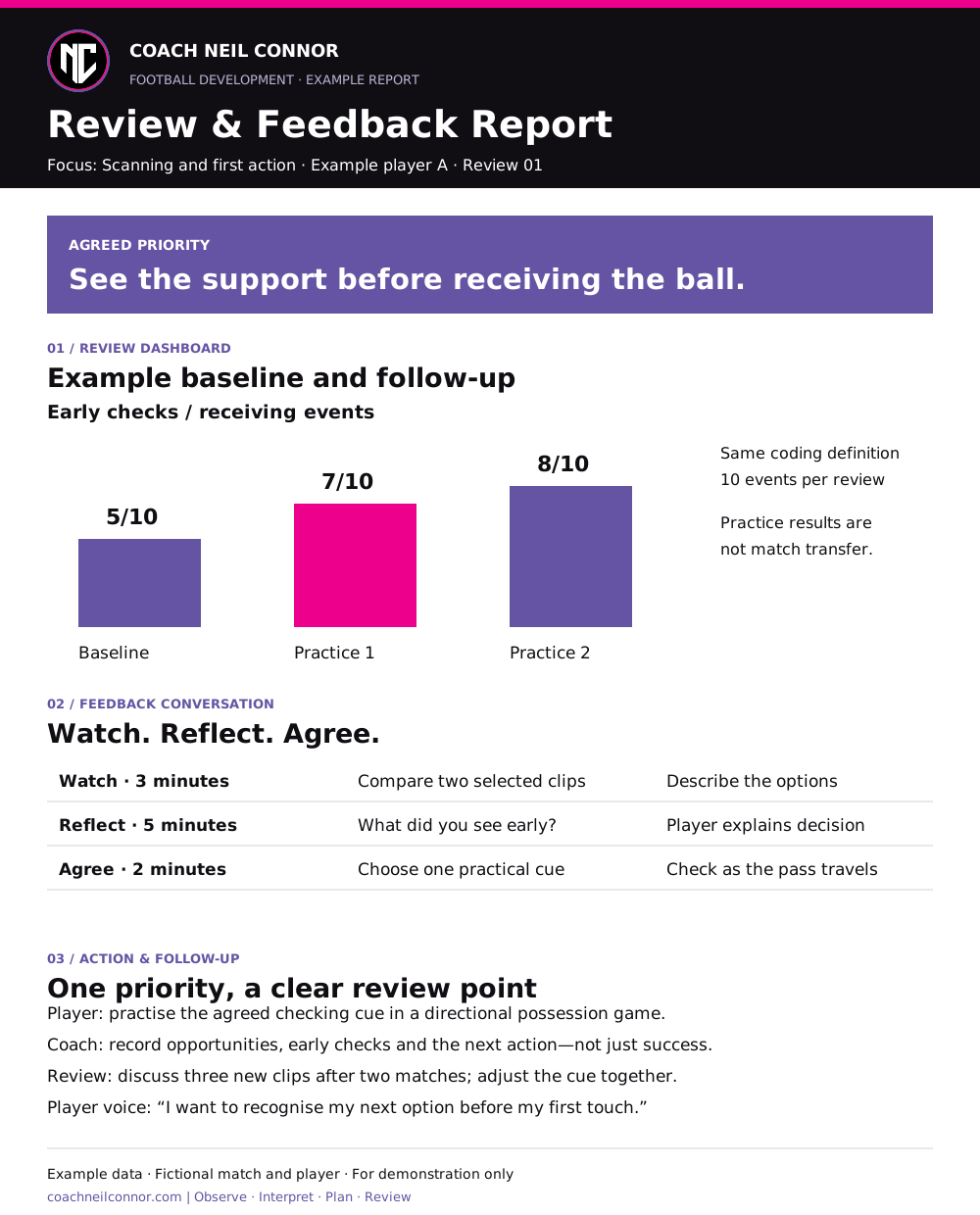
Feedback turns the report into a shared development conversation. The player first watches the selected clips, explains what they noticed and considers the available choices before agreeing a practical cue with the coach.
This example focuses on seeing support before receiving. The dashboard compares early checks across three ten-event reviews: five at baseline, seven in the first practice and eight in the second. Keeping the coding definition consistent makes the comparison useful, but improvement in practice still needs checking in matches.
The conversation follows a simple sequence: watch, reflect and agree. Rather than giving the player several instructions at once, select one cue to trial—such as checking as the pass travels—and decide where the player will practise it.
The follow-up records opportunities, the behaviour observed and the next action, including occasions when the cue did not help. A later match review considers whether the player used the information under different pressure and support conditions, then adjusts the priority together.
From review to practice
Finish with one agreed action, a practice opportunity and a clear review point.
Reviews consider positional roles, team structure, build-up, progression, finishing, defending, transitions and set pieces. Observations are separated from interpretation, with reports adapted to the audience.