What To Prepare
Describe the player’s age group, playing role, current environment and the question you want help with. A brief outline is enough for the initial enquiry; agree the sharing arrangements before sending footage or personal records.
 Neil Connor
Development
Individual development plans, player reviews and practices that connect personal priorities to the game.
01 In Practice
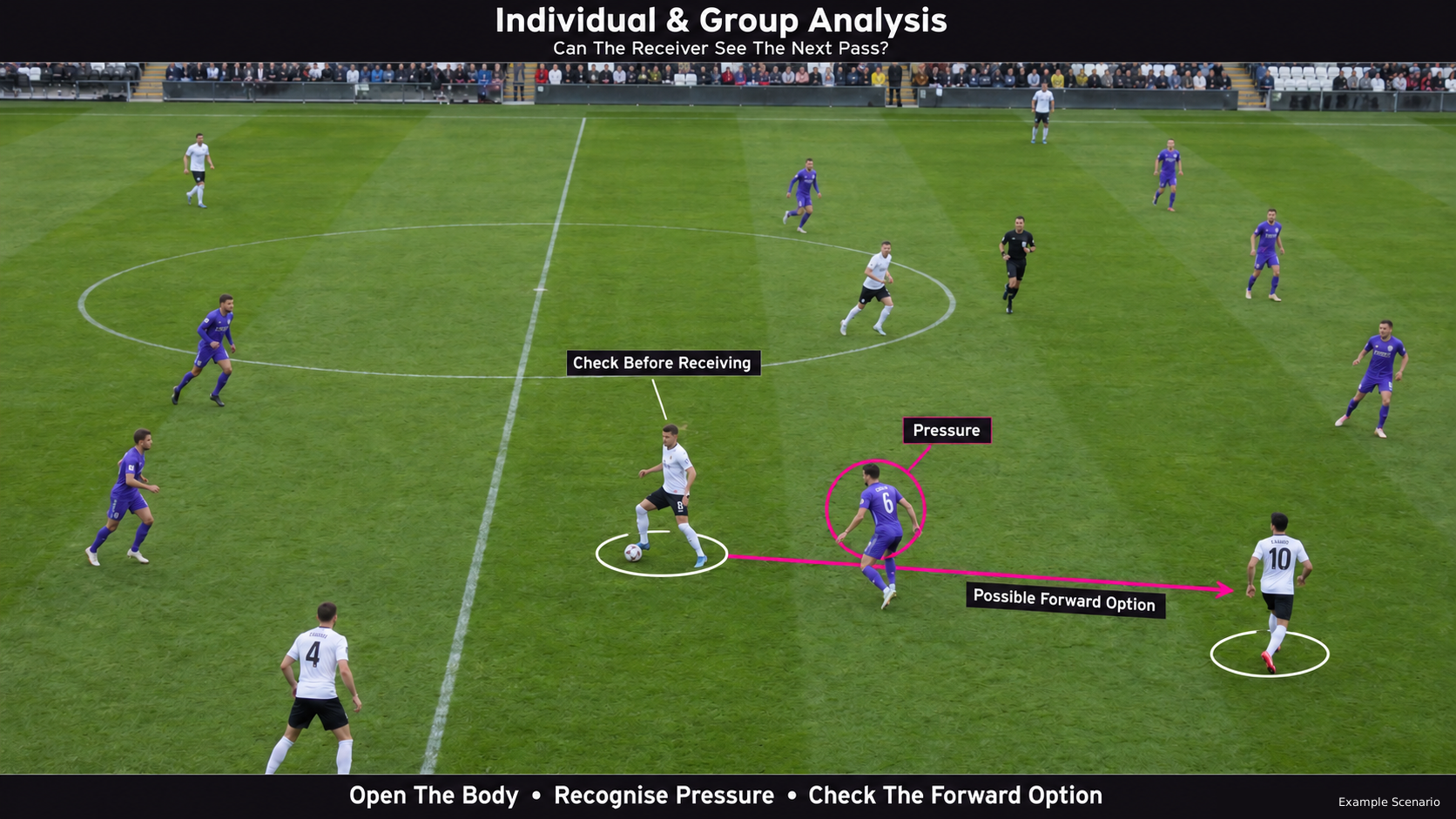
A priority such as ‘improve awareness’ is difficult to practise or review until it describes a situation. For a midfielder receiving under pressure, the focus might be the information available before the pass, the support around them and the choice made with the first touch.
The fictional match image provides a starting point for that discussion. A real review would return to the moving sequence and compare several similar moments. The player’s explanation belongs alongside the coach’s observations before deciding what to practise and what evidence to revisit.
How I Can Help
Bring full-match footage to an initial conversation. Agree the player’s positional context and review question, then use selected clips, a feedback conversation and a small number of priorities to inform the development plan. For younger players, agree parent or club involvement before sharing footage or records.
For an agreed player review, the output brings together the examples examined, the player’s view and a small number of development priorities. We discuss what those priorities mean in practice, who can support them and when to review them. The report format, feedback conversation and any follow-up are agreed before work begins.
A parent-support conversation can instead focus on understanding a concern and preparing clear questions for the club. A written player report is included only when it forms part of the agreed service.
Getting Started
Describe the player’s age group, playing role, current environment and the question you want help with. A brief outline is enough for the initial enquiry; agree the sharing arrangements before sending footage or personal records.
For a younger player, agree parent or carer involvement and an appropriate way to include the player’s own view. Where support relates to the club’s programme, clarify the coach’s involvement and the intended use of the review.
Use the initial conversation to agree whether the support is suitable, the evidence required and the intended output. Confirm the fee, timetable and feedback arrangements before proceeding. Any follow-up review is agreed as part of the scope.
1-to-1 coaching is not currently available. Session blocks and season programmes are coming soon; bookings are closed. Player mentoring, analysis and development support can be discussed separately.
Describe the age group, playing context and support needed in your enquiry. Suitability and scope are agreed before work begins; examples on this site are not a universal programme for every player.
Where the review relates to the club’s programme, agree the coach’s involvement and how findings will be used. Support should help the player understand their next steps within that environment.
A brief outline of the question and playing context is enough. Footage, consent and secure sharing arrangements are agreed before identifiable player material is transferred.
02 Practical Examples
Use a match or practice example to describe the action you want to understand. Describe the pressure, position and options around the player so the observation has a clear context.
Choose a manageable focus with the player and record what progress would look like. Link it to a practice opportunity and include the player’s explanation of what they are trying to change.
Return to the same behaviour in later footage and player reflections. Compare similar situations, include unsuccessful attempts and check whether the player had a genuine chance to use the behaviour.
03 Document Examples
Use the assessment profile to organise observations, then transfer a manageable priority into the development plan. Revisit it with examples from practice and matches, rather than treating a rating as the whole picture.
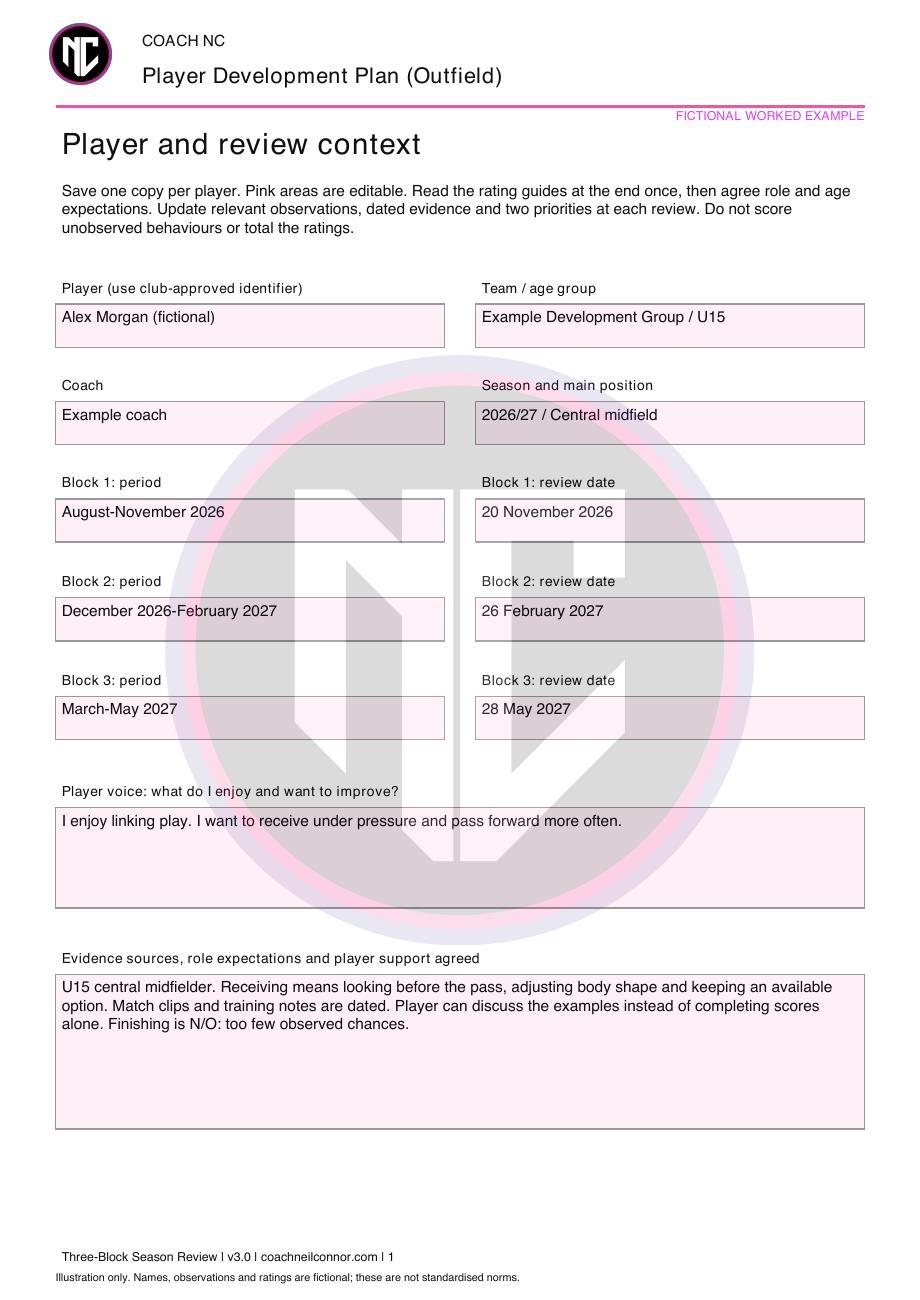
Record the player’s priorities and review points.
Start with the player’s position, current review period and own view of their game. Use a specific observation from training or a match to agree a manageable priority, then describe the practice opportunities and support that will help them work on it.
At the next review, return to that priority with dated examples and the player’s reflection. Discuss what changed, where the behaviour is still difficult and whether the plan needs adjusting. The plan should guide a conversation and the next block of work, rather than become a list of ratings.
View The Pack ↗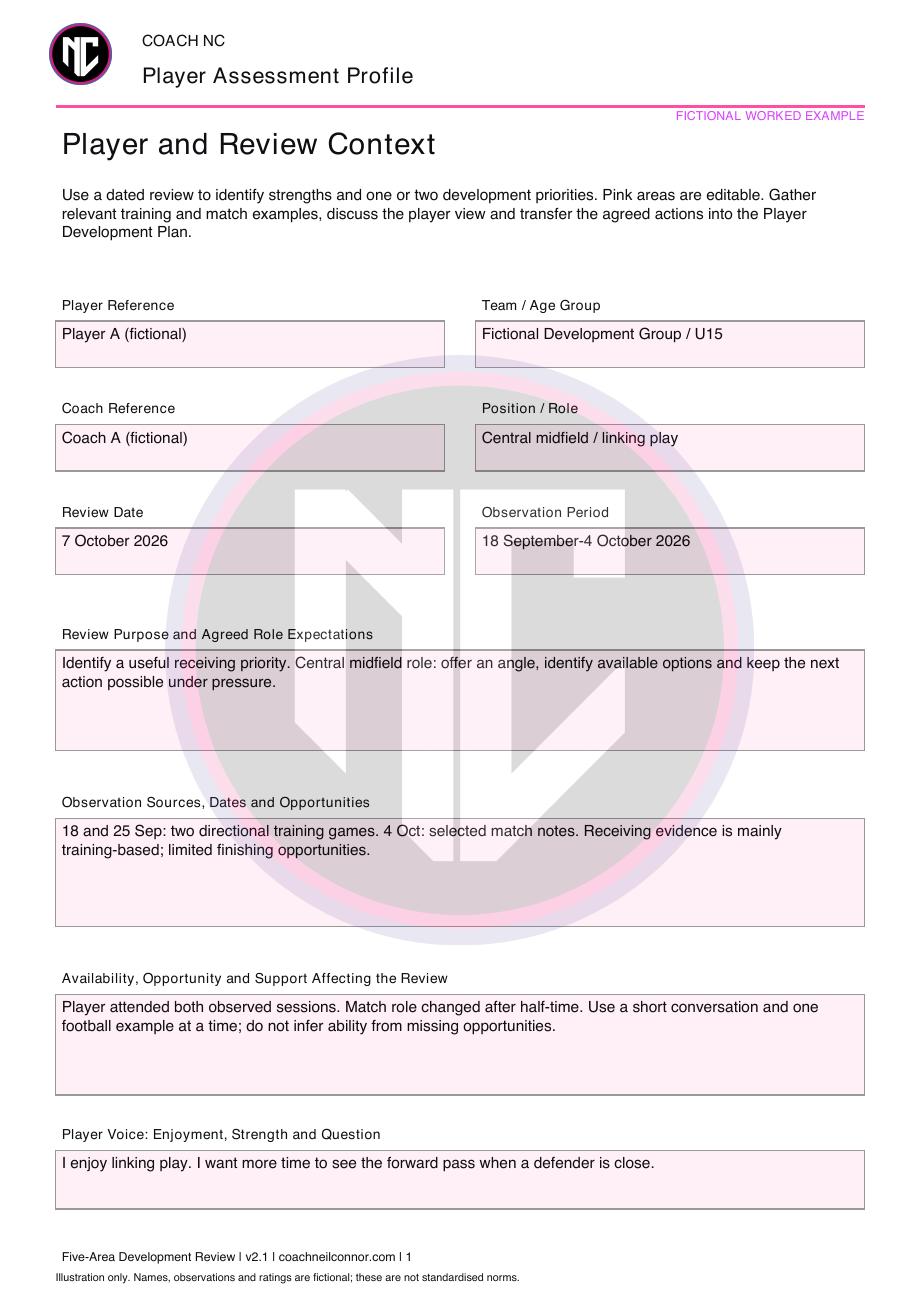
Organise observations before agreeing the development focus.
Bring observations together before deciding what the player needs next. Describe the situation as well as the action: the pressure they faced, the options available and the demands of their position. Include strengths and occasions when the behaviour was less effective.
Compare the coach’s observations with the player’s explanation. Select the most useful development focus and carry it into the Individual Development Plan. A rating can help organise the discussion, but it should be supported by examples and revisited when new evidence is available.
View The Pack ↗Individual video & tactical analysis
Match footage is reviewed through the player’s positional and tactical context to identify strengths, recurring behaviours and priority development areas. The analysis is then converted into coaching priorities that can feed directly into an Individual Development Plan.
View player analysis04 Related Blogs
These articles connect individual, position-specific work with the challenge of transferring learning from training into a match.
Over time, one of the most important areas of player development I have worked on is the design and delivery of individual, position-specific training. While team training forms the foundation of any academy…
Read Article Player DevelopmentOne of the most common frustrations in player development is the gap between what players can do in training and what they produce in matches. It is not unusual to see players execute actions cleanly within sessions,…
Read Article05 Further Reading & Listening
The FIFA resources offer two specific lenses for the review: how a player gathers information, and how individual work relates to their position in the team.
A research-led example of examining how players gather information before acting.
Open Resource ↗Coaching Article · FIFA Training CentreConnects an individual development focus to positional decisions within the team.
Open Resource ↗